|
Key Insights
|
Details
|
|
Forecast Period
|
2025 - 2030
|
|
Market Size (2025)
|
USD 1.79 Billion
|
|
CAGR (2026-2031)
|
9.45%
|
|
Fastest Growing Segment
|
Aquaculture
|
|
Largest Market
|
Asia Pacific
|
|
Market Size (2031)
|
USD 3.08 Billion
|
Market Overview
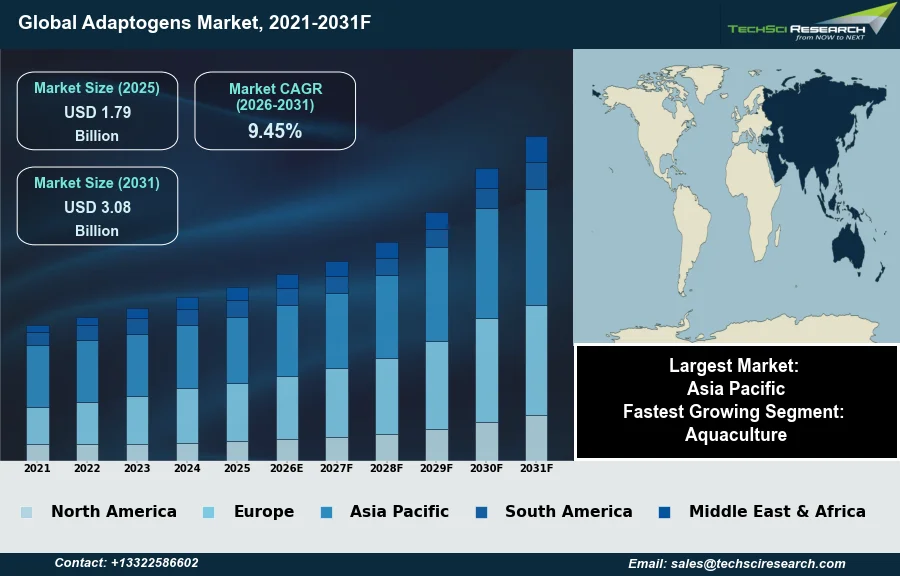
The Global Adaptogens Market is expected to grow from USD 1.79 Billion in 2025 to USD 3.08 Billion by 2031 at a 9.45% CAGR. Adaptogens are a distinct category of non-toxic plants and fungi that support the body's natural ability to manage physical, chemical, and biological stressors, aiding in the restoration of physiological balance. The global adaptogens market is primarily driven by increasing consumer awareness regarding holistic health and wellness benefits, coupled with a rising demand for natural and plant-based solutions for stress management and preventive healthcare. Furthermore, robust scientific validation of their efficacy in enhancing endurance and cognitive function fuels market expansion, particularly in the nutraceutical and functional food sectors. According to APEDA export data, in 2024, India accounted for over 75% of global ashwagandha production, underscoring the significant contribution of specific adaptogens to the broader market.
However, a significant challenge impeding market growth is the limited regulatory harmonization and product standardization across diverse international markets. The varied guidelines and stringent requirements for health claims, particularly in regions like the European Union and North America, create complexities for manufacturers in product approval and marketing strategies.
Key Market Drivers
Global Stress Elevates Demand for Adaptogens
The global adaptogens market is significantly propelled by rising global stress and anxiety levels. Modern lifestyles characterized by demanding work environments and constant digital connectivity contribute to a pervasive sense of pressure, driving consumers to seek natural solutions for mental well-being and resilience. This acute need is evidenced by Gallup's State of the Global Workplace 2026 report, published in April 2026, which states that 40% of employees globally experienced a lot of stress during the previous day in 2025. Adaptogens, known for their ability to support the body's physiological response to various stressors, are increasingly sought for their promise in enhancing cognitive function, improving mood, and fostering a sense of calm. This direct correlation between widespread stress and the demand for natural coping mechanisms underscores its role as a primary market driver.
Wellness Focus and Demographic Shifts Drive Adaptogen Demand
Concurrently, increasing consumer health and wellness awareness profoundly influences the adaptogens market. A growing societal emphasis on preventive healthcare and holistic well-being encourages individuals to proactively manage their health through diet and lifestyle. Consumers are increasingly valuing natural and plant-based ingredients for their perceived safety and efficacy in promoting overall vitality. This commitment to personal health is quantifiable, as a December 2025 nationwide survey from the Health & Fitness Association revealed Americans planned to spend $60 billion in 2026 to support health, fitness, and exercise goals. Furthermore, the heightened focus on preventive health is amplified by demographic shifts; the World Health Organization reported in October 2025 that the global population aged 60 and above is projected to double by 2050, reaching 2.1 billion. This expanding demographic, keenly interested in maintaining healthspan, consistently fuels demand for adaptogenic products.
Download Free Sample Report
Key Market Challenges
Fragmented Regulatory Landscape and Compliance Costs
Limited regulatory harmonization and product standardization across diverse international markets significantly impedes the growth of the global adaptogens market. Manufacturers encounter substantial complexities in product approval and marketing strategies due to varied guidelines and stringent requirements for health claims. This inconsistency often results in adaptogens being classified differently, such as dietary supplements in some regions and herbal medicines in others, creating a fragmented regulatory landscape. Such discrepancies necessitate costly and time-consuming efforts to tailor products and labeling for each market, delaying product launches and increasing operational expenses.
EU Regulatory Fragmentation and Growth Constraints
The challenge is particularly pronounced in major economic blocs. For instance, the European Food Safety Authority (EFSA) imposes rigorous scientific evidence mandates for health claim approvals. This leads to considerable uncertainty for manufacturers seeking to expand, as a single product may require distinct formulations or extensive documentation to comply with varying national or regional standards. According to the European Federation of Associations of Health Product Manufacturers (EHPM), the European food supplement industry generated approximately 18,000 million EUR in revenue in 2024. The lack of a unified approach across such a substantial market segment prevents economies of scale and hinders the efficient flow of adaptogen-based products, thereby restraining overall market expansion.
Key Market Trends
Expansion into Functional Foods and Beverages
The adaptogens market is significantly influenced by its increasing integration into functional food and beverage categories. Consumers seek convenient ways to incorporate these botanicals into daily routines, moving beyond traditional supplements. This trend is driven by a desire for products offering both nutritional value and targeted health benefits, such as stress reduction and cognitive support, within familiar food and drink offerings. Inclusion of adaptogens in items like ready-to-drink teas, smoothies, and functional snacks provides a seamless market entry. According to the Organic Trade Association, April 2025, in 2024, the organic beverage category, which includes adaptogenic ingredients, saw its market sales rise by 5.2%.
Expansion into Personal Care and Skincare
Another pivotal trend is the expansion of adaptogens into personal care and beauty product formulations. As consumers increasingly link internal health with external appearance, there is growing demand for cosmetic products leveraging adaptogens' stress-modulating and antioxidant properties. These ingredients are incorporated into serums, creams, and masks, claiming benefits like improved skin resilience and reduced inflammation. This diversification beyond ingestible forms opens new revenue streams and positions adaptogens as multifaceted wellness ingredients. According to Global Cosmetic Industry, October 2025, the application of adaptogenic ingredients in high-performance skincare is projected to grow by over 60% in 2026.
Segmental Insights
Aquaculture: Fastest-Growing Segment in Animal Nutrition Driven by Adaptogens
In the global adaptogens market, aquaculture is emerging as the fastest-growing segment within animal nutrition. This rapid expansion is primarily driven by the critical need to enhance resilience and mitigate stressors in aquatic species, which often face challenges such as suboptimal water quality, intensive handling, transportation, and high stocking densities. Adaptogens offer a natural solution by improving immune function, reducing stress responses, and boosting overall welfare, thereby minimizing disease susceptibility and supporting sustainable aquaculture practices. The increasing industry focus on responsible farming and the search for alternatives to conventional compounds, as highlighted by research initiatives like the PISCIBIEN project at the University of Cádiz, further propel the adoption of these beneficial botanicals in aquatic feed formulations.
Regional Insights
Asia Pacific: Regional Leader Driven by Traditional Medicine Heritage and Local Raw Material Availability
Asia Pacific stands as a key regional leader in the global adaptogens market, primarily driven by its profound historical ties to traditional medicine systems. Countries like India and China have deeply embedded practices such as Ayurveda and Traditional Chinese Medicine, which extensively utilize adaptogens like ashwagandha and ginseng for centuries to promote overall well-being. This region also benefits from abundant local raw material availability, serving as a significant cultivation and supply hub for many adaptogenic herbs. Furthermore, increasing consumer awareness regarding natural health solutions, coupled with rising urban stress and preventive healthcare trends, consistently fuels demand across the area. Local industry players are capitalizing on these factors, reinforcing Asia Pacific's prominent market position.
Recent Developments
-
In July 2025, BioAdaptives announced the upcoming U.S. release of NeuroRush, an adaptogen-based nootropic product. This "next-generation nootropic" was specifically formulated to support sustained cognitive performance, mental clarity, and stress adaptability, directly addressing demands within the global adaptogens market. NeuroRush featured a blend of six clinically studied adaptogenic ingredients, including Rhodiola rosea, ashwagandha, and Panax ginseng. The company planned to launch the product in two formulations: one with natural caffeine and a caffeine-free version, catering to varied consumer preferences for mental energy and stress control.
-
In March 2025, Moment, a "botanical soda" brand known for its adaptogen-based drinks, announced a collaboration with Crown Holdings, Inc. to enhance its sustainability efforts. This partnership focused on upgrading the aluminum packaging of Moment's drinks sold across the U.S. from shrink-wrapped cans to directly printed cans. The initiative was designed to significantly improve package circularity and reduce environmental impact, reflecting evolving consumer preferences for both healthy and sustainable beverage options within the adaptogens market. Crown Holdings provided expertise in packaging, graphic design, and technical services for this transition.
-
In April 2024, TRIP, a prominent UK soft drinks company, launched a new range of proprietary functional blends, directly impacting the global adaptogens market. This new line incorporated mushrooms and adaptogens, including Lion's Mane and Ashwagandha, into four distinct flavors of soft drinks. The company aimed to offer consumers new ways to achieve calm and manage daily stress, building on the growing momentum of these emerging ingredients. These new offerings position adaptogens within accessible beverage formats, catering to increasing consumer prioritization of health and wellness through functional drinks.
-
In January 2024, Tata Consumer Products, an Indian fast-moving consumer goods company, significantly expanded its presence in the adaptogens market through the acquisition of Organic India. This strategic move integrated Organic India's extensive portfolio of herbal supplements, which prominently feature adaptogenic ingredients such as ashwagandha and tulsi, into Tata’s offerings. The acquisition aimed to address the increasing consumer demand for health-focused and stress-relief products. This allowed Tata to strengthen its wellness segment and meet growing interest in natural health solutions. Organic India, a multinational company, specialized in adaptogenic products, aligning well with Tata Consumer Products' market objectives.
Key Market Players
- Cargill, Incorporated
- DSM-Firmenich AG
- Archer Daniels Midland Company
- Bluestar Adisseo Co.
- Alltech Inc
- Kemin Industries Inc
- Trouw Nutrition International B.V.
- Novus International, Inc.
- Phytobiotics Futterzusatzstoffe GmbH
- EW Nutrition GmbH
|
By Source
|
By Livestock Species
|
By Form
|
By Function
|
By Region
|
- Herbal Adaptogens
- Mushroom Extracts
|
|
|
- Stress-Mitigation Additives
- Immune-Enhancement Applications
|
- North America
- Europe
- Asia Pacific
- South America
- Middle East & Africa
|
Report Scope:
In this report, the Global Adaptogens Market has been segmented into the following categories, in addition to the industry trends which have also been detailed below:
-
Adaptogens Market, By Source:
-
Herbal Adaptogens
-
Mushroom Extracts
-
Adaptogens Market, By Livestock Species:
-
Adaptogens Market, By Form:
-
Adaptogens Market, By Function:
-
Stress-Mitigation Additives
-
Immune-Enhancement Applications
-
Adaptogens Market, By Region:
-
North America
-
United States
-
Canada
-
Mexico
-
Europe
-
France
-
United Kingdom
-
Italy
-
Germany
-
Spain
-
Asia Pacific
-
China
-
India
-
Japan
-
Australia
-
South Korea
-
South America
-
Brazil
-
Argentina
-
Colombia
-
Middle East & Africa
-
South Africa
-
Saudi Arabia
-
UAE
Competitive Landscape
Company Profiles: Detailed analysis of the major companies present in the Global Adaptogens Market.
Available Customizations:
Global Adaptogens Market report with the given market data, TechSci Research offers customizations according to a company's specific needs. The following customization options are available for the report:
Company Information
- Detailed analysis and profiling of additional market players (up to five).
Global Adaptogens Market is an upcoming report to be released soon. If you wish an early delivery of this report or want to confirm the date of release, please contact us at sales@techsciresearch.com