|
Key Insights
|
Details
|
|
Forecast Period
|
2027-2031
|
|
Market Size (2025)
|
USD 571.32 Million
|
|
CAGR (2026-2031)
|
6.03%
|
|
Fastest Growing Segment
|
Polyurethane
|
|
Largest Market
|
South West
|
|
Market Size (2031)
|
USD 811.81 Million
|
Market Overview
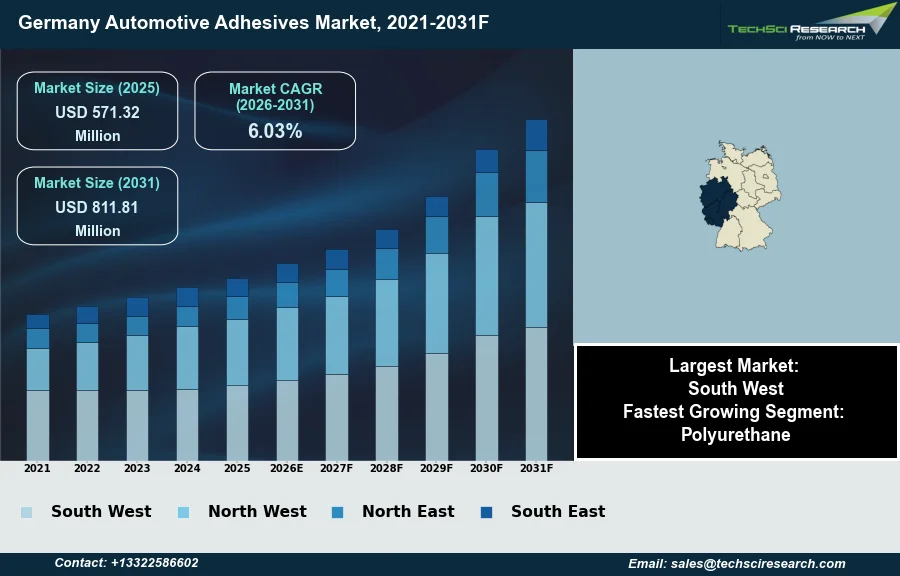
The Germany Automotive Adhesives Market will grow from USD 571.32 Million in 2025 to USD 811.81 Million by 2031 at a 6.03% CAGR. Automotive adhesives comprise specialized bonding, sealing, and gasketing compounds engineered for vehicle assembly and component attachment, frequently replacing traditional mechanical fasteners to enhance performance. The Germany Automotive Adhesives Market is primarily driven by the automotive industry’s persistent pursuit of lightweighting initiatives, which necessitate the bonding of diverse materials such as aluminum and composites to improve fuel efficiency and reduce emissions. Moreover, the accelerating production of electric vehicles substantially boosts demand for adhesives in battery assembly and structural applications. According to the German Association of the Automotive Industry (VDA), in 2025, Germany produced approximately 1.67 million electric vehicles, representing a 23 percent year-on-year increase.
Despite these robust growth drivers, a significant challenge for market expansion remains the volatility of raw material prices, which can impact manufacturing costs and overall market stability.
Key Market Drivers
Lightweight, Multi-Material Architectures Drive Adhesive Demand
Increasing demand for lightweight vehicle construction significantly propels the Germany Automotive Adhesives Market. Automakers consistently pursue weight reduction to enhance fuel efficiency and minimize emissions, a necessity for meeting stringent environmental targets. Adhesives facilitate the bonding of dissimilar materials such as advanced high-strength steels, aluminum alloys, and carbon fiber composites, which cannot be joined effectively by traditional mechanical fasteners. For example, Mercedes-Benz reported in December 2025 that its BIONICAST® process, which involves bionic optimization of cast components, can achieve up to a 25 percent saving in weight and material for certain components compared to conventional counterparts. This ongoing shift towards multi-material architectures directly increases the need for high-performance and multi-functional adhesives that offer superior strength, durability, and vibration damping while contributing to overall vehicle lightness.
Electric Vehicle Growth Expands Adhesive Use in Battery and Structural Bonding
The accelerating production of electric vehicles also serves as a crucial driver for the Germany Automotive Adhesives Market. Electric vehicles require extensive application of adhesives for battery pack assembly, thermal management systems, and structural bonding to ensure safety, integrity, and extended range. Adhesives are essential for sealing battery components against moisture and vibrations, as well as for bonding composite materials in lightweight battery enclosures. According to the German Association of the Automotive Industry (VDA), in December 2025, 1.76 million electric passenger cars are expected to be produced in Germany in 2026. This robust growth in electric vehicle production necessitates a corresponding increase in demand for specialized adhesives. While electric vehicle production shows strong momentum, the broader German passenger car market faces challenges; the VDA also anticipates domestic passenger car production to slightly decline to 4.11 million units in 2026, from 4.15 million units in 2025.
Download Free Sample Report
Key Market Challenges
Raw-material price volatility drives cost and margin pressures.
The volatility of raw material prices presents a significant challenge for the Germany Automotive Adhesives Market. Fluctuations in the cost of key inputs such as polymers, resins, and specialized chemicals directly inflate manufacturing expenses for adhesive producers. This unpredictability hinders effective cost planning and budgeting, leading to reduced profit margins across the sector. Companies face constant pressure to either absorb these higher costs, impacting their financial health, or pass them on to automotive manufacturers.
Price instability dampens R&D and innovation amid underutilization.
Such price instability can deter investment in research and development for new, advanced adhesive formulations crucial for lightweighting initiatives and electric vehicle battery assembly. Consequently, the ability of German adhesive manufacturers to innovate and meet the evolving demands of the automotive industry is directly hampered. According to the German Chemical Industry Association (VCI), sector capacity utilization for chemicals averaged a record low of 70% in 2025, with half of companies lacking sufficient order volumes to remain profitable. This indicates a strained operational environment where cost pressures from raw materials directly contribute to underutilization and decreased profitability within the broader chemical industry, including adhesive production.
Key Market Trends
Sustainable Adhesives Driven by Regulation and Circular Economy
Widespread adoption of sustainable adhesive formulations is a pivotal trend in the Germany Automotive Adhesives Market, driven by stringent environmental regulations and the industry’s commitment to a circular economy. This entails developing and integrating bio-based, solvent-free, and low VOC adhesives, reducing manufacturing's environmental footprint and enhancing component recyclability. German automotive manufacturers increasingly invest in these solutions for climate-neutral mobility. According to the German Association of the Automotive Industry (VDA), in its November 2025 "VDA Statement regarding COP30", German manufacturers and suppliers plan to invest approximately €320 billion in global research and development between 2025 and 2029, with a substantial portion dedicated to sustainable materials and bonding technologies.
Robotic Automation of Adhesive Dispensing
The integration of automated adhesive application technologies forms another significant trend, enhancing manufacturing efficiency and product quality. This involves deploying robotic systems for precise and consistent adhesive dispensing, minimizing human error and material waste. Automated processes are essential for bonding complex multi-material structures and high-volume production in modern vehicle assembly lines. These technologies ensure superior bond integrity and repeatability, crucial for vehicle safety and durability. For instance, an article from "Adhesive Dispensing Robot: Complete Guide for Manufacturers," published in March 2026, states that robotic systems can reduce bond strength variance from up to 20 percent to a mere 5 percent, improving reliability and decreasing rework.
Segmental Insights
Polyurethane Adhesives: Fastest-Growing Segment in Germany's Automotive Market for Lightweight and EV Applications
In the Germany Automotive Adhesives Market, polyurethane emerges as the fastest-growing segment. This significant growth is primarily fueled by the automotive industry's intensive focus on lightweight vehicle construction to meet stringent environmental regulations and enhance fuel efficiency, particularly within the expanding electric vehicle sector. Polyurethane adhesives are crucial for effectively bonding diverse lightweight materials, such as aluminum and composites, which are difficult to join using conventional methods. Their superior mechanical properties, including high strength, flexibility, and resistance to various conditions, also make them indispensable for critical applications like battery assembly in electric vehicles, supporting Germany's drive towards advanced and sustainable mobility solutions.
Regional Insights
OEM Concentration and R&D Drive Market Leadership in South West Germany
The South West of Germany stands as a prominent region within the Germany Automotive Adhesives Market, driven by its unparalleled concentration of leading automotive manufacturers. This area, particularly Baden-Württemberg, is home to major premium automotive brands such as Mercedes-Benz and Porsche, headquartered in Stuttgart, and Audi with a significant presence in Neckarsulm. The robust presence of these Original Equipment Manufacturers (OEMs), coupled with extensive automotive research and development activities, generates a substantial demand for advanced adhesive solutions. Continuous innovation in lightweight construction, electric vehicle development, and advanced assembly techniques by these key players necessitates high-performance, specialized adhesives, thereby solidifying the South West's dominant position in the market.
Recent Developments
-
In December 2025, Henkel introduced Loctite MS 9650, a new generation adhesive and sealant designed to address the evolving demands of the automotive industry. This product, based on a silane-modified polymer, was engineered for durable and lightweight structural bonding, particularly for automotive display components. It was noted for its excellent flexibility, strong vibration resistance, and creep behavior, matching silicone-based adhesives. The silicone-free and low-VOC formula of Loctite MS 9650 also contributed to improved operator safety and minimized environmental impact in production, aligning with sustainability goals in the German automotive sector.
-
In April 2025, Henkel showcased advancements in adhesive and sealing solutions crucial for electric vehicle (EV) battery technologies, directly impacting the Germany Automotive Adhesives Market. The company highlighted its AI-powered simulation capabilities for generating virtual adhesives, which aimed to shorten development cycles and reduce prototyping costs for OEMs and battery manufacturers. Additionally, Henkel's debonding innovations for structural adhesives were presented, facilitating non-destructive disassembly and repair of EV batteries. These breakthroughs supported end-of-line repairs, second-life applications, and end-of-life recycling, enhancing sustainability across the battery lifecycle in the automotive sector.
-
In February 2025, ElringKlinger, a German automotive supplier, expanded its aftermarket chemical product portfolio with the introduction of two new high-performance, two-component adhesives under the LiqRep brand. These new products, LiqRep Plastic and LiqRep Metal, were specifically developed for fast and professional repairs of engines, metal components, and bodywork in the automotive and transportation industries. LiqRep Plastic is a fast-curing polyurethane adhesive suitable for structural and cosmetic plastic repairs, while LiqRep Metal is an epoxy resin-based adhesive offering strong adhesion to various metals. These adhesives aimed to enhance efficiency for automotive workshops across 26 European countries.
-
In September 2024, Sika Automotive's SikaSeal®-832 solution was recognized as a finalist for the 2025 Automotive News PACE Awards, highlighting its innovative contribution to the Germany Automotive Adhesives Market. This pumpable baffle adhesive, part of the SikaSeal® family, was developed to significantly improve noise, vibration, and harshness (NVH) performance in vehicles. Its pumpable application process allows for precise, automated installation, which can reduce labor costs for manufacturers. The solution also demonstrated adaptability to complex geometries and adhered to stringent VOC regulations, promoting sustainability in automotive manufacturing processes.
Key Market Players
- Henkel AG & Co. KGaA
- Sika AG
- 3M Company
- Arkema S.A.
- H.B. Fuller Company
- Dow Inc.
- BASF SE
- Huntsman Corporation
- H.B. Fuller Company (LORD Corporation)
- Wacker Chemie AG
|
By Type
|
By Formulation
|
By Region
|
- Epoxy
- Polyurethane
- Acrylic
- Silicone
|
- Water-Based
- Solvent-Based
- Hot-Melt
- Others
|
- South-West
- North-West
- North-East
- South-East
|
Report Scope:
In this report, the Germany Automotive Adhesives Market has been segmented into the following categories, in addition to the industry trends which have also been detailed below:
-
Germany Automotive Adhesives Market, By Type:
-
Epoxy
-
Polyurethane
-
Acrylic
-
Silicone
-
Germany Automotive Adhesives Market, By Formulation:
-
Water-Based
-
Solvent-Based
-
Hot-Melt
-
Others
-
Germany Automotive Adhesives Market, By Region:
-
South-West
-
North-West
-
North-East
-
South-East
Competitive Landscape
Company Profiles: Detailed analysis of the major companies present in the Germany Automotive Adhesives Market.
Available Customizations:
Germany Automotive Adhesives Market report with the given market data, TechSci Research offers customizations according to a company's specific needs. The following customization options are available for the report:
Company Information
- Detailed analysis and profiling of additional market players (up to five).
Germany Automotive Adhesives Market is an upcoming report to be released soon. If you wish an early delivery of this report or want to confirm the date of release, please contact us at sales@techsciresearch.com