|
Forecast Period
|
2026-2030
|
|
Market Size (2024)
|
USD 15.4 Billion
|
|
Market Size (2030)
|
USD 19.6 Billion
|
|
CAGR (2025-2030)
|
3.9%
|
|
Fastest Growing Segment
|
Concrete
|
|
Largest Market
|
North America
|
Market Overview
The
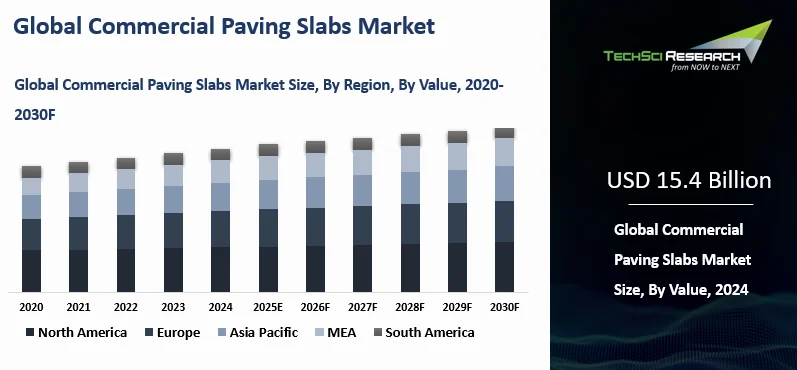
Global Commercial Paving Slabs Market was valued at USD 15.4 billion
in 2024 and is expected to reach USD 19.6 billion by 2030 with a CAGR of 3.9%
through 2030.
The global commercial paving slabs market is being
driven by rapid urbanization and the expansion of infrastructure projects
across emerging and developed economies. As cities grow, the demand for
aesthetically appealing, durable, and low-maintenance outdoor surfaces in
public spaces, commercial complexes, and transportation hubs increases
significantly. Governments are investing heavily in smart cities and green
infrastructure, which fuels the need for high-quality paving materials.
Sustainability is a major driver, with growing emphasis on environmentally
friendly slabs such as permeable or recycled options that support stormwater
management and reduce environmental impact.
Additionally, commercial and hospitality sectors
are increasingly using paving slabs to enhance the visual appeal and
functionality of outdoor spaces, boosting demand for customizable designs,
textures, and finishes. Technological advancements in manufacturing have
improved product durability and installation efficiency, further encouraging
adoption. Digital tools like Building Information Modeling (BIM) and automation
in production also support better planning and execution. Moreover, rising
awareness of climate-resilient materials is pushing the use of paving slabs in
climate-sensitive regions. Overall, a combination of economic development,
sustainability goals, aesthetic demands, and technological progress continues
to propel the commercial paving slabs market forward across global regions.
Download Free Sample Report
Key Market Drivers
Rapid Urbanization and Infrastructure Development
One of the key drivers of the global commercial paving slabs market is the fast pace of urban growth paired with steady infrastructure expansion. As cities extend and rural zones shift into urban centers, demand has increased in commercial spaces such as airports, malls, hotels, hospitals, business parks, and campuses. Urban projects focus on functional, clean outdoor layouts, and paving slabs support walkways, parking zones, plazas, and landscaped areas.
Governments in China, India, Brazil, and several African countries are raising spending on public assets, smart cities, and transport links. Programs such as India’s Smart Cities Mission and China’s Belt and Road plan include large paving and landscaping work. Developed regions are also upgrading old assets, which keeps demand stable.
Paving slabs offer strong load capacity, weather resistance, simple installation, and flexible design. Their long life and low upkeep suit high-traffic sites. As cities add more sustainable features, slabs made from recycled inputs or with permeable structures are gaining traction because they support better water flow and cleaner construction goals. These factors place paving slabs as a steady, long-term choice for public and commercial buildouts.
Global construction is set to grow at a 6-8 percent CAGR through the next five years. Annual infrastructure spending is projected to cross USD 4 trillion by the mid-2020s. Urban projects make up about 55 percent of the total construction value. Housing builds are rising at 7–9 percent each year, and commercial projects are expanding at 5-7 percent. Asia, Africa, and Latin America contribute nearly 60 percent of the growth in infrastructure development. Smart city and green asset spending is increasing at 12-15 percent per year. PPP projects are growing at about 10 percent annually, and total materials demand is expected to rise 4–6 percent each year over the next decade..
Sustainability Trends and Green Building
Initiatives
The rising focus on sustainability has become a strong growth driver in the commercial paving slabs market. Governments, developers, and builders are moving toward greener construction, which supports demand for slab materials that meet standards such as LEED and BREEAM. Permeable slabs are seeing wider adoption because they help manage stormwater, reduce runoff, and improve groundwater recharge in dense urban zones. Recycled and low-carbon inputs also help cut the environmental impact of new projects.
Developers are using slabs made from reclaimed concrete, natural stone, and by-products like fly ash to align with circular economy goals. Producers are investing in cleaner methods, including energy-efficient kilns and better waste control, to serve clients who prefer sustainable options. Rules in Europe, North America, and parts of Asia-Pacific are adding pressure to choose greener materials, and certifications are giving builders a clear edge in commercial real estate.
Sustainable slabs support technical needs and add to the environmental score of a project, which matters for investors seeking resilient assets. As climate concerns shape planning and procurement choices, demand for green paving slabs is set to rise.
The global green building sector is expanding at about 10-12 percent each year. Green construction makes up 30-35 percent of new projects. Spending on sustainable materials is expected to pass USD 300 billion within five years. Energy-efficient buildings reduce total construction energy use by 20-25 percent worldwide. Certification adoption is rising by about 15 percent per year. Renewable energy use in buildings is growing at 18-20 percent annually. Green retrofits are increasing at roughly 12 percent per year, and water-efficient systems are present in more than 40 percent of new builds..
Key Market Challenges
High Raw Material and Installation Costs
Rising costs remain a major constraint for the global commercial paving slabs market. Prices of cement, aggregates, natural stone, porcelain, and composite materials have increased because of energy costs, inflation, and supply chain issues. Energy-heavy processes, especially for ceramic or stone slabs, raise production expenses and tighten margins for producers.
Installation costs add further pressure. Commercial sites need trained labor, machinery, strict safety compliance, and precise placement to handle high foot and vehicle load, which raises total project spending. These costs discourage buyers in price-sensitive regions, where asphalt or compacted gravel often replace slabs due to lower upfront spend despite higher upkeep over time.
Manufacturing and transport also require high capital because slabs are heavy and costly to move and handle. This reduces profitability for both producers and contractors and slows adoption in public projects and smaller commercial builds. Without advances in low-cost production or support programs for sustainable materials, high expenses will continue to limit wider use of commercial paving slabs.
Environmental and Regulatory Constraints
Environmental and regulatory pressures have become a major challenge for the global commercial paving slabs market. Slab producers face strict rules on carbon output, water use, and waste control. Cement and concrete contribute heavily to global CO₂ emissions, so manufacturers must adopt cleaner processes, emissions systems, and alternative inputs, which raise production costs.
Quarrying for granite, sandstone, and limestone faces growing criticism because it affects landscapes, habitats, and water bodies. Several countries have tightened mining rules, limited licenses, or raised export duties. These steps restrict supply and disrupt trade flows, especially for natural stone from India, China, and Brazil.
Urban heat concerns add further pressure. Standard paving slabs store heat and raise surface temperatures, so many cities now require reflective or cool paving materials. This forces producers to update product lines to meet new planning norms. Longer approval cycles tied to environmental reviews also slow project starts and create uncertainty for contractors. For global suppliers, handling varied compliance rules across regions adds another layer of complexity.
These combined pressures increase costs and require steady innovation, which is difficult for small and mid-sized producers trying to stay competitive..
Key Market Trends
Rising Demand for Sustainable and Permeable Paving
Solutions
One of the strongest trends shaping the global commercial paving slabs market is the shift toward sustainable and permeable paving. As cities face issues such as flooding, water stress, and rising surface temperatures, planners and developers are choosing solutions that support cleaner and safer urban spaces. Permeable slabs help water move through the surface, cut runoff, and support groundwater recharge while easing pressure on drainage systems.
These slabs are gaining use in areas with strict environmental rules or high rainfall. Many are produced with recycled or low-carbon inputs, including reclaimed concrete, crushed glass, fly ash, or rubber composites, which align with LEED and BREEAM goals. Demand is supported by buyers and investors who prefer responsible development, and by government programs that promote green materials.
Producers are raising R&D spending to expand eco-friendly lines. Some now offer slabs with photocatalytic surfaces that help break down harmful gases under sunlight. The wider shift toward sustainability has become a strategic priority, pushing companies to move from traditional products to climate-resilient, recyclable, and durable options. Over time, these solutions will shape how commercial outdoor spaces are planned and maintained..
Integration of Advanced Manufacturing and Design
Technologies
A major trend shaping the global commercial paving slabs market is the use of advanced manufacturing and design technologies. As commercial spaces place more value on both function and appearance, producers are turning to digital tools, automation, and precision methods to raise product quality and meet specific design needs.
Technologies such as 3D printing, robotics, and CNC machining help create detailed textures, patterns, and shapes. These tools allow slabs to mimic natural stone or wood at lower cost with steady output. Digital modeling systems, including BIM, help architects test layouts and performance before installation, which cuts errors and speeds project work.
Smart production methods support modular systems that improve alignment and allow faster installation, which matters in large commercial sites. Surface treatments such as anti-slip coatings, UV protection, and self-cleaning finishes help slabs perform better in varied climates. Customization is also rising. Developers now want designs that match brand goals or landscape themes, and CAD tools help producers offer a wide range of finishes, colors, and formats.
These advances raise efficiency and help manufacturers deliver higher-value, differentiated slabs. This trend will grow further in premium commercial projects where appearance, reliable performance, and innovation guide material choices..
Segmental Insights
Application Insights
Walkways & Pedestrian
Areas segment dominated the Commercial Paving Slabs Market in 2024 and is
projected to maintain its leadership throughout the forecast period, driven by
the increasing need for durable, safe, and visually appealing public spaces.
Urbanization and infrastructure development have led to a surge in the
construction of commercial walkways, plazas, sidewalks, and pedestrian zones
across cities worldwide. These areas not only serve as essential connectors
within commercial environments but also enhance the overall aesthetic and
functionality of outdoor spaces. Commercial paving slabs are widely favored in
such applications due to their strength, longevity, low maintenance, and wide
range of design options.
Governments and
municipalities are placing greater emphasis on creating walkable urban
environments to encourage healthier lifestyles, reduce vehicular traffic, and
promote tourism. This trend is especially strong in regions with active urban
planning initiatives such as Europe, North America, and parts of Asia-Pacific.
The demand for slip-resistant, weather-resistant, and easy-to-install slabs has
risen, particularly in commercial areas like shopping centers, office
complexes, parks, and transport terminals.
Moreover, the push toward
sustainability is influencing the choice of materials for walkways, with
permeable and eco-friendly paving slabs gaining preference to manage stormwater
and reduce urban heat islands. With continuous innovation in design and materials,
the Walkways & Pedestrian Areas segment is expected to maintain its leading
position in the commercial paving slabs market in the foreseeable future.

Download Free Sample Report
Regional Insights
Largest Region
North America dominated the Commercial Paving Slabs
Market in 2024 and is anticipated to maintain its leadership throughout the
forecast period, driven by strong infrastructure development, urban renewal
projects, and the growing focus on sustainable and aesthetic outdoor design.
The United States and Canada have witnessed consistent investment in commercial
construction, including shopping malls, business districts, educational
campuses, and public spaces such as parks and plazas. This has created a high
demand for durable, visually appealing paving solutions suitable for heavy foot
traffic and varying climate conditions.
One of the key reasons for North America's
dominance is its early adoption of innovative construction technologies and
materials. The region has seen a strong shift toward the use of permeable and
eco-friendly paving slabs, which support stormwater management, meet
environmental regulations, and align with LEED and other green building
standards. In addition, local governments and urban planners are placing
increased emphasis on creating walkable cities, leading to more
pedestrian-friendly zones that require high-quality paving materials.
The presence of well-established manufacturers, a
mature construction industry, and widespread availability of advanced design
and installation techniques have further supported the market’s growth.
Moreover, consumer preferences in North America favor customized and
high-performance slab options that complement modern architectural styles. With
continued investments in infrastructure modernization and sustainable urban
design, North America is expected to maintain its leadership position in the
commercial paving slabs market in the coming years, setting benchmarks for
innovation and quality in commercial paving applications.
Emerging Region
South America is the emerging region in the Commercial
Paving Slabs Market, fueled by increasing urbanization, infrastructure
investments, and a growing emphasis on public space enhancement. Countries such
as Brazil, Argentina, Chile, and Colombia are witnessing significant
development in commercial construction, including shopping complexes, business
districts, tourist destinations, and public transport terminals. As these
countries work to modernize their urban infrastructure, the demand for durable
and visually appealing paving solutions is on the rise.
Government-led urban renewal programs and private
sector investments are driving the development of walkways, plazas, and
pedestrian-friendly zones in major cities. There is also an increasing focus on
improving the quality of public spaces to support tourism and local economic
activity, particularly in areas with high foot traffic. As a result, commercial
paving slabs are gaining traction due to their long lifespan, low maintenance,
and design flexibility.
While cost has traditionally been a barrier to
market expansion in the region, the availability of cost-effective materials
and locally produced paving solutions is improving market accessibility. In
addition, there is a growing awareness of environmentally friendly construction
practices, leading to rising interest in permeable and recycled paving slabs.
With economic recovery in progress and
infrastructure funding improving in several South American countries, the
region is positioned to see strong growth in the commercial paving slabs
market. Its untapped potential, combined with shifting construction trends,
makes South America a key emerging market for industry players in the years
ahead.
Recent Developments
- In June 2024, SiteOne Landscape Supply acquired AC Florida Pavers, which operates as Hardscape.com. The deal expands SiteOne’s hardscape reach across the U.S. and Canada through four Florida sites in Boca Raton, Fort Myers, Tampa, and Jupiter, and gives the company exclusive access to Saxa Gres Italian porcelain outdoor pavers.
- In July 2024, Wells acquired GATE Precast to widen its footprint and diversify its prefabricated building lineup. The move strengthens Wells’ ability to deliver complete precast concrete systems, including paving slabs and structural parts across several sectors.
- In August 2024, Oldcastle APG, a CRH company, bought Master Block, Inc., a concrete block producer in El Mirage, Arizona. This deal boosts Oldcastle APG’s masonry and fence block capacity in the Phoenix area and supports rising demand in the fast-growing Southwest region.
- In September 2025, CRH finalized its USD 2.1 billion purchase of Eco Material Technologies, first announced in July 2025. The acquisition brings a leading North American SCM supplier into CRH’s operations and supports its shift toward advanced cement and concrete solutions used in paving and core infrastructure projects.
- In July 2025, Trinity Hunt Partners made a majority investment in DACS Asphalt & Concrete to build a commercial paving services platform. The investment supports expansion plans through strategic deals and organic growth across North America.
- May 2025 – Nicolock Paving Stones, Retaining Walls, and Outdoor Living, a leading provider of premium hardscape solutions, proudly unveils its new Design Studios. These innovative spaces are thoughtfully created to help homeowners bring their outdoor living dreams to life—offering a seamless journey from concept to completion. Far more than traditional showrooms, the Nicolock Design Studios provide an immersive, hands-on experience. Visitors can visualize how Nicolock’s wide selection of products will look once installed, boosting confidence and making decision-making easier and more intuitive.
- February 2024 – Techo-Bloc announces the exciting debut of its Studio Collection for public spaces—a bold, forward-thinking addition to the landscape architecture world. This groundbreaking collection empowers designers to create custom, futuristic paving layouts, offering over 800 unique design combinations across a rich selection of patterns and color palettes. Designed exclusively for commercial and public landscapes, the Studio Collection brings a fresh surge of inspiration to the design community.
Key Market
Players
- Boral Limited
- Wienerberger
AG
- Tobermore
Concrete Products Ltd.
- Marshalls
plc
- Basalite
Concrete Products, LLC
- Paving
Superstore Ltd.
- Techo-Bloc
Inc.
- Brett
Landscaping and Building Products
|
By Material
|
By
Application
|
By Region
|
- Concrete
- Clay
- Stone
- Crushed
Stone
- Others
|
- Walkways
& Pedestrian Areas
- Patios &
Outdoor Living Spaces
- Parking lots
& Driveways
- Pool Decks
& landscaping
- Others
|
- North
America
- Europe
- Asia
Pacific
- South
America
- Middle East
& Africa
|
Report Scope:
In this report, the Global Commercial Paving Slabs
Market has been segmented into the following categories, in addition to the
industry trends which have also been detailed below:
- Commercial Paving Slabs
Market, By Material:
o Concrete
o Clay
o Stone
o Crushed Stone
o Others
- Commercial Paving Slabs
Market, By Application:
o Walkways &
Pedestrian Areas
o Patios & Outdoor
Living Spaces
o Parking lots &
Driveways
o Pool Decks &
landscaping
o Others
- Commercial Paving Slabs Market, By Region:
o North America
§
United
States
§
Canada
§
Mexico
o Europe
§
Germany
§
France
§
United
Kingdom
§
Italy
§
Spain
o Asia Pacific
§
China
§
India
§
Japan
§
South
Korea
§
Australia
o South America
§
Brazil
§
Colombia
§
Argentina
o Middle East & Africa
§
Saudi
Arabia
§
UAE
§
South
Africa
Competitive Landscape
Company Profiles: Detailed analysis of the major companies
present in the Global Commercial Paving Slabs Market.
Available Customizations:
Global Commercial Paving Slabs Market report
with the given market data, TechSci Research offers customizations according
to a company's specific needs. The following customization options are
available for the report:
Company Information
- Detailed analysis and
profiling of additional market players (up to five).
Global Commercial Paving Slabs Market is an
upcoming report to be released soon. If you wish an early delivery of this
report or want to confirm the date of release, please contact us at sales@techsciresearch.com