RTX wins European certification for Pratt & Whitney’s GTF Advantage
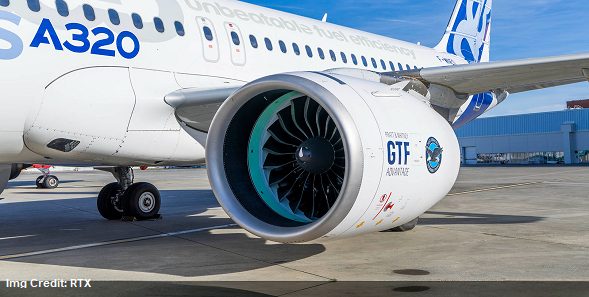
The upgraded A320neo-family engine
sharpens payload, range, and durability economics for airlines chasing
efficiency gains.
United
States: RTX said the European Union Aviation Safety Agency (EASA) certified
Pratt & Whitney’s GTF Advantage engine for the Airbus A320neo family,
clearing the way for production deliveries and entry into service. The GTF
Advantage engine was certified by the U.S. Federal Aviation Administration in
February 2025 and EASA validated the engine's type certification in October
2025. The engine offers 4% to 8% more take-off thrust, enabling higher payload
and longer range. The company expects the GTF Advantage to become the
production standard, with a full cutover from older GTF variants by 2028. RTX
also noted that Pratt & Whitney continues to invest in production capacity,
including nearly $1 billion in Asheville, North Carolina, and $200 million in
Columbus, Georgia.
According
to Rick Deurloo, president of Commercial Engines at Pratt & Whitney,
“The GTF engine delivers the lowest fuel consumption for single-aisle
aircraft.” "The GTF Advantage engine extends that lead offering up to
double the time on wing and enhancing aircraft capability providing even
greater value to operators of A320neo family aircraft. This aircraft
certification is a key milestone for the GTF Advantage program in advance of
its entry into service."
According to TechSci
Research, this certification is strategically important because single-aisle
economics remain the center of gravity for commercial aerospace. Airlines want
narrowbody aircraft that can fly farther, carry more payload, and burn less
fuel without moving to larger widebody platforms. The GTF Advantage is
therefore not just an engine upgrade; it is a competitive tool for airlines
optimizing route flexibility, emissions exposure, and maintenance economics.
The “time on wing” benefit is especially important in a market where shop-visit
timing and engine availability materially affect fleet utilization. For
suppliers and MRO providers, the development could support demand in spare
parts, predictive maintenance, overhaul planning, and airport network
optimization. It also shows how propulsion innovation is becoming a major
commercial differentiator at a time when airlines are under pressure to improve
profitability and environmental performance simultaneously.