|
Key Insights
|
Details
|
|
Forecast Period
|
2027-2031
|
|
Market Size (2025)
|
USD 1.12 Billion
|
|
CAGR (2026-2031)
|
12.33%
|
|
Fastest Growing Segment
|
Electric
|
|
Largest Market
|
Dubai
|
|
Market Size (2031)
|
USD 2.25 Billion
|
Market Overview
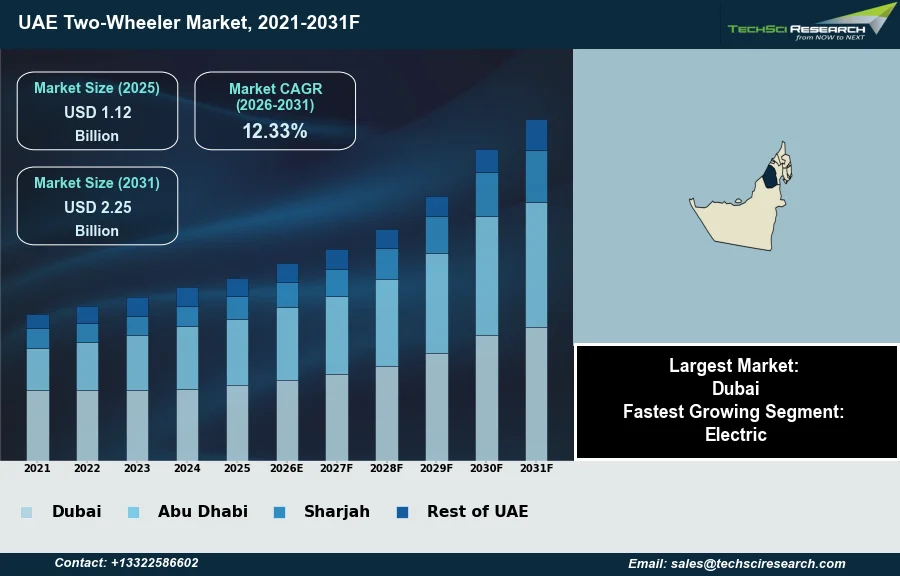
The UAE Two-Wheeler Market will grow from USD 1.12 Billion in 2025 to USD 2.25 Billion by 2031 at a 12.33% CAGR. The UAE Two-Wheeler market encompasses motorcycles, scooters, and mopeds, serving both personal mobility and commercial logistics requirements. This market's growth is primarily driven by increasing urbanization and persistent traffic congestion, which elevates the demand for agile and efficient transportation solutions. Further impetus comes from the robust expansion of e-commerce and last-mile delivery services, necessitating a flexible and cost-effective fleet. According to the Roads and Transport Authority (RTA), motorcycle registrations in the UAE increased by 12% between 2019 and 2023, reflecting a growing preference for personal mobility options.
Additionally, government initiatives promoting sustainable transport and electric mobility contribute significantly to market expansion. However, a notable challenge impeding market expansion is the extreme climatic conditions, particularly high summer temperatures, which limit the usability and comfort of two-wheelers for extended periods.
Key Market Drivers
E-commerce Expansion Driving Two-Wheeler Fleet Growth
The expansion of e-commerce and last-mile delivery services significantly propels the UAE Two-Wheeler Market. The rapid growth of online retail has generated substantial demand for efficient and agile transportation solutions to fulfill delivery commitments. Two-wheelers are particularly well-suited for navigating urban environments, ensuring timely and cost-effective delivery of goods. This has led to a noticeable increase in fleets operated by e-commerce giants and food delivery platforms. According to Sharikat Mubasher, in September 2025, Noon, a leading e-commerce platform, reported its gross merchandise value reached an estimated $5–6 billion in 2024, underscoring the immense scale of online transactions requiring robust logistical support. This commercial imperative drives continuous investment in two-wheeler fleets and associated infrastructure to meet escalating consumer expectations for swift delivery.
Electric Mobility Policies Accelerating Two-Wheeler Adoption
Concurrently, government initiatives promoting electric mobility are a key catalyst for market evolution. The UAE government is actively fostering a sustainable transport ecosystem, with policies and incentives aimed at increasing the adoption of electric vehicles, including two-wheelers. This strategic focus is designed to reduce carbon emissions and diversify energy sources within the transportation sector. According to the Dubai Electricity and Water Authority (DEWA), in October 2025, electric motorcycle sales in the UAE increased by 30% annually from 2021 to 2024, reflecting a growing shift towards cleaner mobility solutions. Such proactive government support, alongside the inherent agility and fuel efficiency of two-wheelers, contributes to their increasing appeal. Overall, the foundational role of two-wheelers in the transportation landscape is further highlighted by data from the UAE Ministry of Interior, which stated that in 2023, motorcycles accounted for approximately 7% of total registered vehicles in the country.
Download Free Sample Report
Key Market Challenges
Extreme Summer Heat Limiting Two-Wheeler Adoption and Logistics
A notable challenge impeding the expansion of the UAE Two-Wheeler market is the region's extreme climatic conditions, particularly the high summer temperatures. These elevated temperatures, which frequently surpass 40 degrees Celsius during the warmer months, significantly limit the practicality and comfort of using motorcycles, scooters, and mopeds for extended periods. This directly impacts both personal mobility and commercial logistics.
Heat-Driven Barriers to Adoption and Market Growth
For individual consumers, the intense heat deters prolonged outdoor travel, making two-wheelers a less appealing option compared to enclosed, air-conditioned alternatives. Similarly, for businesses relying on two-wheelers for last-mile delivery and e-commerce services, operating efficiency is compromised. Riders face increased health risks and discomfort, leading to reduced operational hours and potential strain on delivery networks. While precise aggregate data from industrial associations directly correlating seasonal temperatures with two-wheeler market contraction for the last year is not publicly detailed under the specified criteria, the operational realities underscore a significant reduction in usability during these peak summer months, thereby slowing overall market growth.
Key Market Trends
Growth of Recreational Riding and Premium Leisure Models
Two significant trends are currently shaping the UAE Two-Wheeler market, extending beyond basic transportation needs. The first notable trend is the burgeoning growth of a recreational and leisure riding culture. This shift moves beyond commuting and commercial logistics, reflecting a consumer desire for experiences, specialized vehicles, and community engagement. The increasing affluence in the region, coupled with diverse landscapes ranging from urban roads to desert trails, fuels demand for high-performance and luxury two-wheelers for recreational purposes. For instance, the Harley-Davidson UAE official website in June 2026 displayed the 2025 Harley-Davidson Road King Special with a price of AED 155,000, illustrating the robust market for premium leisure models. This indicates a growing segment of buyers willing to invest significantly in two-wheelers for lifestyle and enjoyment.
Smart, Connected Technologies in UAE Two-Wheelers
Concurrently, the integration of smart and connected technologies is emerging as a transformative trend, enhancing both safety and rider experience. This involves incorporating features such as advanced navigation systems, telematics for real-time diagnostics, and smartphone connectivity. Such technological advancements appeal to tech-savvy consumers and improve the overall functionality and security of two-wheelers. For example, in February 2026, Sharmax Motors noted that manufacturers are increasingly focusing on incorporating modern electronics into their models to cater to evolving consumer preferences in the UAE. While specific aggregate sales figures for smart two-wheelers for the past year are not readily available from permitted sources, this focus on technological integration underscores a strategic direction for manufacturers within the UAE market.
Segmental Insights
Policy, Incentives, and Infrastructure Driving Electric Two-Wheeler Growth
The Electric segment stands as the fastest-growing category within the UAE Two-Wheeler Market, reflecting a significant shift towards sustainable transportation. This rapid growth is primarily fueled by the UAE government's strong commitment to green mobility, evidenced by the comprehensive National Electric Vehicles Policy and ambitious Net Zero 2050 Strategic Initiative. Regulatory bodies, such as the Dubai Electricity and Water Authority (DEWA), are instrumental in expanding the necessary charging infrastructure across the emirates. Moreover, the provision of various incentives, including reduced registration fees, alongside a growing environmental awareness among consumers and businesses, significantly drives the adoption of electric two-wheelers. The inherent operational cost efficiencies of these vehicles further reinforce their appeal as practical and eco-friendly urban mobility solutions.
Regional Insights
Dubai: Dominant UAE Market for Two-Wheelers
Dubai consistently leads the UAE Two-Wheeler Market, primarily due to its highly urbanized environment and sophisticated infrastructure. The city's thriving e-commerce and food delivery sectors significantly boost demand for efficient last-mile transportation, which two-wheelers effectively provide amidst urban congestion. Furthermore, Dubai's progressive embrace of micro-mobility solutions and electric scooters, supported by government initiatives like the Roads and Transport Authority's (RTA) Smart Mobility program and its extensive EV charging network, promotes sustainable urban transport. This dynamic ecosystem, coupled with a dense population and robust tourism, solidifies Dubai’s position as the dominant regional market for two-wheelers.
Recent Developments
-
In April 2025, UAE electric motorbike company Sulmi announced its intention to manufacture 200 limited-edition EB-One electric motorbikes for the consumer market within the Emirates. The EB-One was designed and developed entirely in the UAE, featuring patented SEU technology related to its battery methodology and energy management. Furthermore, the motorbike integrates artificial intelligence capabilities through its Sulmi Rider Assist System, which is engineered to enhance rider safety and collect relevant operational data. This initiative marks a significant advancement in local electric two-wheeler production and technological innovation in the UAE.
-
In February 2025, the Integrated Transport Centre (Abu Dhabi Mobility) entered into a partnership with GIGATONS, a company specializing in net-zero e-mobility solutions. This collaboration focuses on developing innovative solutions for sustainable, smart, and zero-emission electronic mobility in Abu Dhabi, including the establishment of multi-modal charging stations for various electric vehicles, such as electric bicycles. The agreement represents a significant step towards transitioning to green mobility within the emirate and supports the UAE's broader sustainability goals.
-
In October 2024, Triumph Motorcycles officially re-entered the UAE market by forming a strategic distribution partnership with Galadari. This collaboration established Galadari as the authorized partner responsible for the import, sales, service, and overall distribution of Triumph Motorcycles and associated products in the United Arab Emirates. The alliance is anticipated to significantly bolster Triumph's brand presence and accessibility for motorcycle enthusiasts across the UAE, which is recognized as a key market within the GCC region for two-wheelers.
-
In March 2024, Aramex, a prominent logistics and transportation solutions provider, integrated a new fleet of fully electric motorcycles into its last-mile delivery operations throughout the UAE. This strategic deployment is a component of the company's broader long-term objective to achieve a 98% electric vehicle fleet by 2030. The introduction of these electric two-wheelers aims to establish improved benchmarks for sustainable and efficient logistics within the region, thereby contributing to reduced carbon emissions and enhanced operational efficiency in the UAE delivery sector.
Key Market Players
- Honda UAE
- Yamaha UAE
- Suzuki UAE
- Kawasaki UAE
- TVS Motor UAE
- Bajaj Auto UAE
- Hero MotoCorp UAE
- Royal Enfield UAE
- Piaggio UAE
- KTM UAE
|
By Vehicle Type
|
By Propulsion Type
|
By Region
|
|
|
|
- Dubai
- Abu Dhabi
- Sharjah
- Rest of UAE
|
Report Scope:
In this report, the UAE Two-Wheeler Market has been segmented into the following categories, in addition to the industry trends which have also been detailed below:
-
UAE Two-Wheeler Market, By Vehicle Type:
-
UAE Two-Wheeler Market, By Propulsion Type:
-
UAE Two-Wheeler Market, By Region:
-
Dubai
-
Abu Dhabi
-
Sharjah
-
Rest of UAE
Competitive Landscape
Company Profiles: Detailed analysis of the major companies present in the UAE Two-Wheeler Market.
Available Customizations:
UAE Two-Wheeler Market report with the given market data, TechSci Research offers customizations according to a company's specific needs. The following customization options are available for the report:
Company Information
- Detailed analysis and profiling of additional market players (up to five).
UAE Two-Wheeler Market is an upcoming report to be released soon. If you wish an early delivery of this report or want to confirm the date of release, please contact us at sales@techsciresearch.com