BASF Commissions New Aroma Ingredients Plants in Germany and China
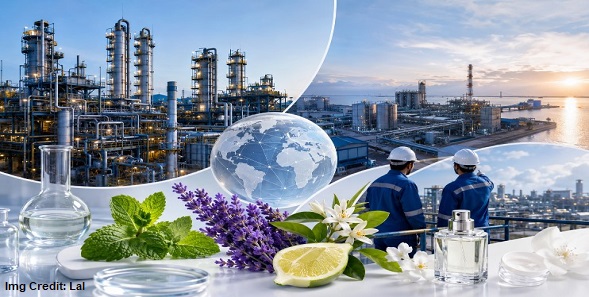
BASF commissions new world-scale aroma
ingredients plants in Germany and China to strengthen supply reliability and
customer reach.
China:
BASF has officially launched three newly built world-scale plants within its
aroma ingredients business: menthol and linalool facilities in Ludwigshafen,
Germany, and a citral plant in Zhanjiang, China. The company said the
investment in Ludwigshafen alone is in the triple-digit million-euro range,
with commercial production of menthol and linalool starting in April 2026.
The
new citral plant in Zhanjiang will supply both the local market and BASF’s
downstream aroma ingredients production chain, including the expanded menthol
and linalool output in Ludwigshafen. BASF stated that the new assets will
improve supply reliability, enhance resource efficiency through Verbund
integration, and support rising demand from the fragrance and flavour industry
across key growth markets. The project has also created 60 new jobs in
Ludwigshafen.
According
to Dr. Katja Scharpwinkel, Member of the Board of Executive Directors of BASF
SE and Site Director of Ludwigshafen, “These
investments underscore the advantages of the Verbund within BASF’s global
production network and represent a clear commitment to the Ludwigshafen site.” Further,
Steffen Goetz, Senior Vice President, Global Aroma Ingredients, said “the
added capacities will support more opportunities for customers in the fragrance
and flavour industry while increasing supply reliability, and added that BASF
now has “one of the broadest asset footprints in the industry.”
According
to TechSci Research, BASF’s expansion is
significant because it combines two important industry themes: speciality
chemicals localisation and integrated global supply-chain design. Aroma
ingredients are high-value, application-sensitive products used across personal
care, home care, food, and pharmaceutical formulations. In such markets,
consistency of supply and product performance are as important as price. By
linking a new citral plant in China with downstream menthol and linalool
production in Germany, BASF is building a more resilient and interconnected
value chain that can serve both regional and international customers.
The move also
illustrates how major chemical producers are prioritising asset integration
rather than isolated capacity additions. BASF’s Verbund model gives the company
operating leverage through shared feedstocks, utilities, infrastructure, and
process know-how. This should help improve efficiency while supporting
sustainability goals. Commercially, the investment positions BASF to respond to
demand growth in fragrance and flavour applications, particularly in
Asia-Pacific and Europe. It also signals confidence in speciality chemicals
despite broader industry volatility. In TechSci Research’s view, chemical
producers with diversified footprints, integrated production, and
customer-linked capacity expansion will be better placed to defend margins and
capture premium demand over the medium term.