Evonik aligns advanced materials with China’s industrial transformation agenda
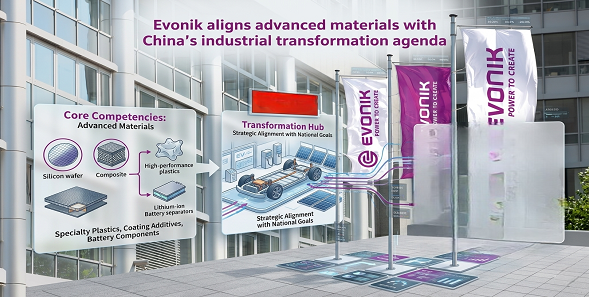
The company is positioning its polymers
and additives around electric mobility, personalised healthcare, advanced
manufacturing and circular plastics.
Shanghai,
China: Evonik announced on 9 April 2026 that it would
showcase its high-performance polymers and plastic additives at Chinaplas 2026
under a theme centred on sustainability, energy transition, smart
manufacturing, personalised healthcare and the circular economy. The company
highlighted solutions for battery thermal management, new-energy vehicle
components, low-altitude aircraft, additive manufacturing, medical applications
and recycling-related process improvement. It also noted that its PA12 polymerisation
reactor project in Shanghai had entered trial production, effectively doubling
its long-chain polyamide capacity in Asia.
This
combination of market-facing application messaging and underlying regional
capacity expansion makes the announcement commercially meaningful. Evonik is
not simply presenting products at an industry event; it is demonstrating
alignment with sectors that China regards as strategically important for its
next phase of industrial development. That gives the company stronger
positioning in discussions with OEMs and manufacturers looking for materials
partners rather than commodity suppliers.
According
to Xia Fuliang, President of Evonik Greater China, “Material
innovation is the core driving force for industrial development and sustainable
transformation. Evonik is committed to breaking the boundaries of material
science through cross-industry collaboration and local R&D investment,
creating more possibilities for future industrial development.”
According to TechSci
Research, Evonik’s strategy illustrates how advanced materials companies are
increasingly shifting from product-centric selling to sector-centric
positioning. In high-growth industrial economies such as China, chemicals
suppliers can create stronger long-term value when they align technologies with
strategic end-use themes such as electrification, healthcare innovation,
high-performance manufacturing and circularity. TechSci Research believes this
improves customer relevance because purchasing decisions in these sectors are
often linked to system performance, regulatory fit and future-proofing, rather
than only raw material cost. The firm also sees Evonik’s expansion of
PA12-related capacity in Asia as an important commercial signal. When
market-facing innovation is backed by local production capability, suppliers
can offer both development support and supply reliability, which enhances their
value proposition to OEMs. In this sense, Evonik’s announcement reflects a
broader industry pattern: growth is increasingly being captured by materials
companies that can attach themselves to structural industrial change rather
than compete only on isolated product features.