Eastman gains a visible sustainability adoption win with Philips Walita
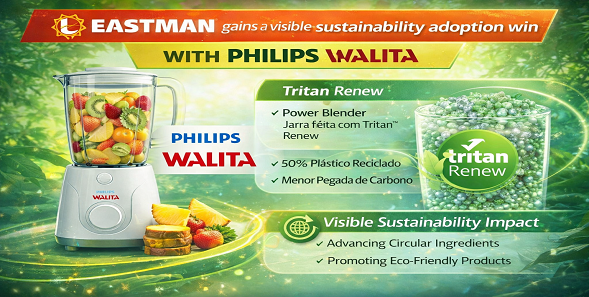
The adoption of Tritan Renew in a premium
blender application strengthens the commercial case for molecularly
recycled-content materials in consumer durables.
São
Paulo, Brazil: Eastman announced on 7 April 2026 that
Philips Walita had adopted Tritan Renew copolyester in the jar design of its
premium 5000 Series RI2242/90 blender. The product had previously used legacy
Tritan, but the shift to Tritan Renew adds certified recycled content while
maintaining performance, clarity, durability and safety. This matters
commercially because it shows how advanced sustainable materials can be
integrated into high-use food-contact applications without forcing redesign or
performance compromise. It also gives Eastman a clear downstream
consumer-facing example of how molecular recycling can support branded product
sustainability objectives.
The
broader relevance of the announcement lies in the adoption setting. Consumer
appliances are visible, quality-sensitive products where material changes can
have direct implications for durability, appearance, user trust and brand
positioning. When a recognised consumer brand adopts recycled-content specialty
material in such an application, it strengthens commercial credibility for the
supplier and may encourage other OEMs to evaluate similar transitions. In that
sense, the announcement is not just a product-material substitution; it is a
market validation event for a category of premium sustainable polymers.
According
to Thais Nascimento, marketing lead for the Philips Walita Latin America
region, “Switching the RI2242/90 jar to Tritan Renew allows us to
deliver the same BPA-free product quality and user experience our customers
trust while taking a meaningful step forward in our sustainability journey.
This change reflects our broader commitments to circular materials, reduced
carbon emissions and more responsible product design for Brazilian consumers.” Further,
Alessandra Lancellotti, business development manager for Eastman, added,
“We’re proud to support Philips Walita as they integrate recycled-content
materials into a high-use food contact application. Tritan Renew delivers the
same clarity and durability designers and consumers rely on while enabling
brands to meet stronger sustainability expectations.”
According to TechSci
Research, sustainable-material adoption in branded consumer products is one of
the clearest signals that advanced recycling technologies are moving from
concept validation toward repeatable commercial demand. Materials such as
Tritan Renew must compete not only on environmental positioning but also on
visual quality, processing compatibility, product safety and end-consumer
trust. TechSci Research believes the Philips Walita adoption is meaningful
because it demonstrates that recycled-content specialty plastics can perform in
premium, food-contact applications where compromise is rarely acceptable. The
firm also notes that downstream consumer adoption can have a multiplier effect
across the value chain. Once a visible appliance brand validates a sustainable
material at scale, it can influence peer OEMs, contract manufacturers and
retailers to explore similar conversions. For Eastman, such wins help build
market confidence around molecular recycling as a commercially viable pathway
rather than a niche sustainability narrative. This may support broader adoption
in appliances, housewares and other high-performance consumer categories.