BASF Bolsters European BDO Production Capacity Amid Antidumping Measures
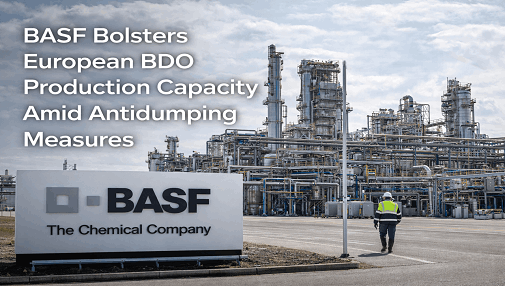
European
chemical giant responds to supply security concerns by expanding 1,4-butanediol
output at flagship German facility.
Ludwigshafen,
Germany: BASF's Intermediates division is taking
decisive steps to strengthen supply security for its European customers in the
1,4-butanediol (BDO) value chain by gradually increasing production output at
its BDO plant in Ludwigshafen, Germany. The expansion comes in response to the
European Commission's February 2026 antidumping duties imposed on BDO imports
from China, Saudi Arabia, and the United States, ranging from 52.4% to 142.5%.
The increased production leverages BASF's highly integrated Verbund structure
encompassing the entire acetylene value chain, which reinforces availability of
key derivative products including tetrahydrofuran (THF), polytetrahydrofuran
(PolyTHF), and N-methylpyrrolidone (NMP). These derivatives serve critical downstream
markets spanning polymers, solvents, elastomers, and high-performance
materials. The strategic move aims to minimize transport requirements while
reducing product carbon footprints through localized manufacturing
efficiencies.
According
to Verena Siegel, Vice President Global Business Management for Butanediol and
Derivatives in BASF’s Intermediates division, “In an
environment of shifting global markets and growing regionalization, robust and
reliable regional production capabilities are becoming increasingly critical
for our downstream industries.” Sebastian Spicher, Senior
Product Manager for Acetylene and Butanediol, “Producing
more BDO in Ludwigshafen allows us to minimize transport needs and draw on the
efficiencies of our integrated Verbund, resulting in a reduced PCF. At the same
time, we are advancing new solutions that make use of renewable electricity and
renewable raw materials.”
According to TechSci
Research, BASF's capacity expansion in Ludwigshafen represents a strategic pivot
toward regional supply chain resilience amid escalating trade barriers in the
global chemical industry. The decision underscores the growing trend of
reshoring critical chemical production capabilities within Europe, particularly
as antidumping measures reshape competitive dynamics. By leveraging its
integrated Verbund system, BASF is well-positioned to capture market share
previously held by lower-cost Asian and Middle Eastern producers while
simultaneously advancing sustainability objectives through reduced
transportation emissions and biomass-balanced product offerings. This expansion
signals a potential stabilization in European BDO markets, benefiting
downstream industries that have faced supply volatility and price fluctuations
from import dependencies.