AbbVie Commits $380 Million to Expand U.S. API Manufacturing Capabilities
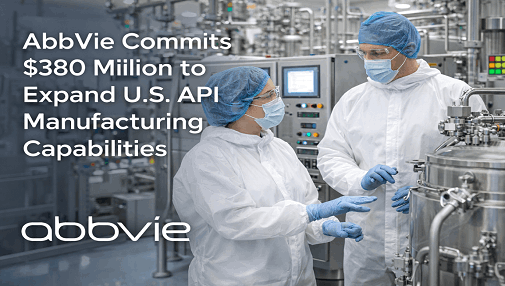
Pharmaceutical giant accelerates domestic
production expansion amid tariff pressures and supply chain reshoring
initiatives.
North
Chicago, Illinois, United States: AbbVie announced on
February 23, 2026, a $380 million investment to construct two new active
pharmaceutical ingredient (API) manufacturing facilities at its North Chicago,
Illinois campus, expanding domestic production capacity for neuroscience and
obesity medicines. Construction at the new facilities will commence in spring
2026, with full operational readiness targeted for 2029. The investment forms
part of AbbVie's broader strategy to scale up domestic manufacturing in
response to the Trump administration's 100% tariff on branded pharmaceutical
drugs imposed in October 2025, which applies only to producers who had not
broken ground on U.S. manufacturing plants prior to the tariff implementation.
The new facilities will integrate advanced manufacturing technologies and
artificial intelligence to support production of future pipeline medicines,
with API production representing one of the most complex steps in
pharmaceutical manufacturing. AbbVie plans to hire 300 personnel in North
Chicago, including engineers, scientists, manufacturing operators, and
laboratory technicians. This investment supplements a previously announced $195
million expansion at the same North Chicago site and contributes to AbbVie's
decade-long $100 billion commitment to U.S.-based research and development
announced in January 2026.
According
to Robert A. Michael, Chairman and Chief Executive Officer, AbbVie, “This
milestone demonstrates further progress against our $100 billion commitment to
U.S. R&D and capital investments over the next decade. By strengthening our
U.S. manufacturing capabilities, we are well-positioned to support our
investment in innovation and enhance our ability to deliver next-generation
medicines to patients.”
According
to TechSci Research, AbbVie's substantial API
manufacturing expansion exemplifies the pharmaceutical industry's strategic
response to escalating U.S. trade protectionism and heightened emphasis on
supply chain sovereignty. The timing of the investment immediately following the
100% branded drug tariff implementation demonstrates proactive regulatory
navigation to maintain market access advantages. By establishing domestic API
production capabilities for high-value neuroscience and obesity therapeutics,
AbbVie insulates its fastest-growing product portfolios from import disruptions
while potentially qualifying for favorable regulatory treatment under emerging
domestic manufacturing incentives. The integration of advanced manufacturing
technologies and AI positions these facilities as next-generation production
assets capable of supporting complex molecular entities and biologics. This
investment trend toward pharmaceutical reshoring is likely to accelerate across
the industry, particularly for companies with significant exposure to
import-dependent supply chains, potentially reshaping global pharmaceutical
manufacturing geography and creating long-term competitive advantages for firms
that execute capacity expansions swiftly.
According to a report
published by Techsci Research, Active
Pharmaceutical Ingredient Market - Global Industry Size, Share,
Trends, Opportunity, and Forecast, Segmented By Type of Synthesis (Biotech,
Fermentation, Plant Extracts, Synthetic), By Application (Cardiovascular
Disease, Oncology, Neurological Disorders, Orthopedic Disorders, Respiratory,
Gastrointestinal Disorders, Urology, Others), By Region and Competition,
2020-2030F, Global Active Pharmaceutical Ingredient Market was valued at
USD 155.41 Billion in 2024 and is expected to reach USD 227.67 Billion by 2030
with a CAGR of 6.77%. As pharmaceutical companies continue to expand their drug
portfolios, the demand for high-quality APIs has intensified across therapeutic
areas such as oncology, cardiovascular disease, neurology, diabetes, and
respiratory disorders. The growing incidence of these conditions, coupled with
an aging global population and changing lifestyles, has created sustained
pressure on pharmaceutical manufacturers to ensure a reliable supply of
effective, affordable APIs.