Forecast Period | 2026-2030 |
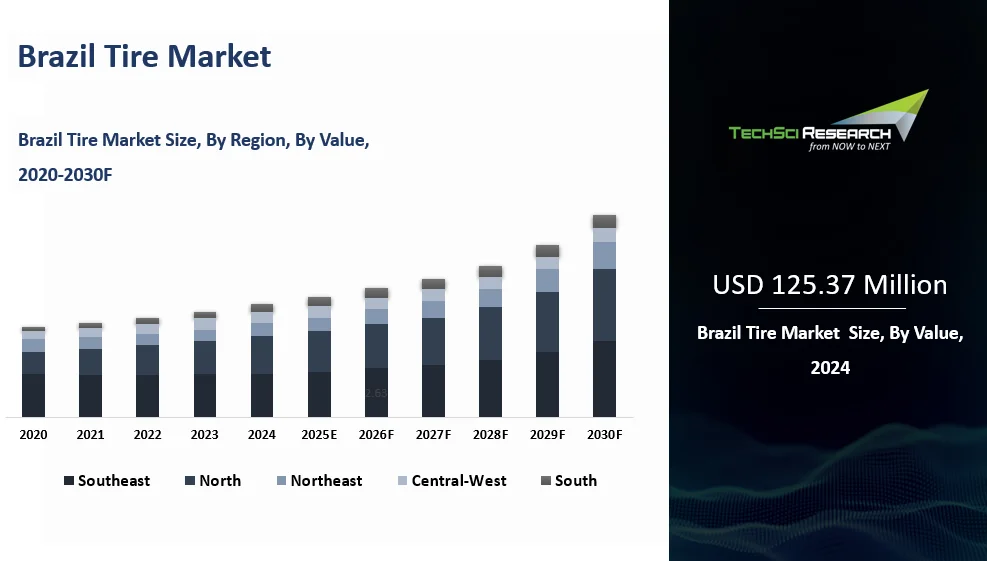
Market Size (2024) | USD 125.37 Million |
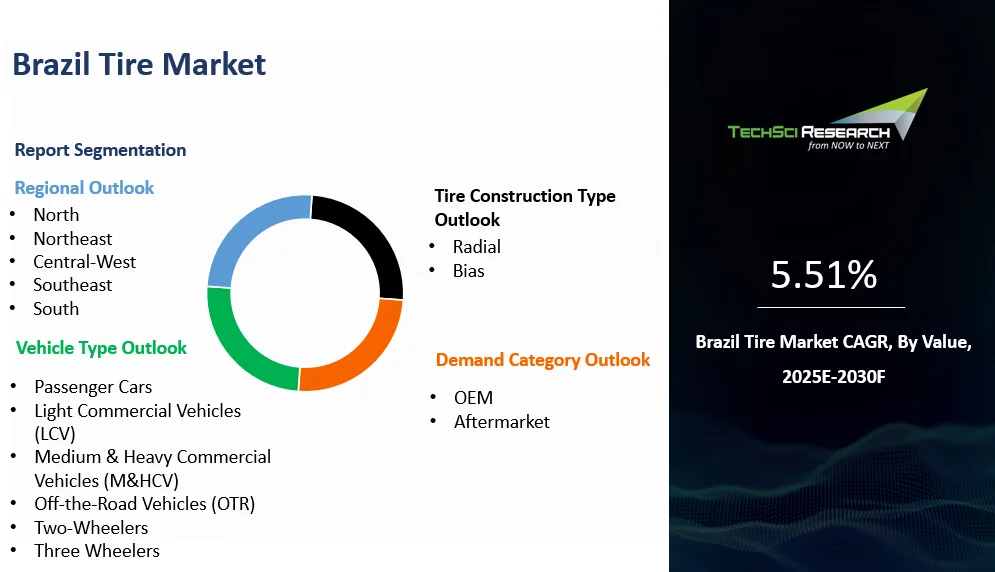
CAGR (2025-2030) | 5.51% |
Fastest Growing Segment | Passenger Cars |
Largest Market | Southeast |
Market Size (2030) | USD 172.96 Million |
Brazil Tire Market Overview:
Brazil Tire Market was valued at
USD 125.37 Million in 2024 and is expected to reach USD 172.96 Million by 2030
with a CAGR of 5.51% during the forecast period. The prospects of the
Brazilian tire market are bright due to a well-developed automotive industry as
well as the previously mentioned history of market growth. The case of market
has recorded massive growth in the past few years attributed to the following
factors which depicts the growth potential of the market. The sales of
automobiles have increased greatly due to an increase in the middle class
population and better standard of living which has in turn created a huge
market for tires. As a part of this, as of October 2024, Brazil's new
vehicle market expanded dramatically in September 2024, with sales up 19.57
percent over the previous year. The National Federation of Motor Vehicle
Distribution (ANFAVEA) reported 236,353 units sold. With increasing
number of car owners as more Brazilians are able to afford cars, there will be
demand for new tires as well as replacement ones. As such, this trend generates
a constant stream of demand for tire manufacturing companies and distributors, which
forms a stable market base. The growth of the vehicle population guarantees an
ever-growing market for both the original equipment and replacement tires.
Key Report Takeaways
- Rising vehicle ownership and expanding middle-class population driving sustained OE and replacement tire demand, supported by over 2 million registered freight trucks nationwide.
- Passenger car segment leading 2024 market share fueled by consumer preference for durability, fuel efficiency, low noise, and safety, alongside EV growth (+91% sales increase to 93,927 units in 2023 per Brazilian Electric Vehicle Association).
- Commercial vehicle and logistics expansion strengthening tire consumption with road freight accounting for over 60% of total cargo transport (per Ministry of Infrastructure), increasing demand for heavy-duty, long-haul tires.
- Southeast Brazil dominating regional demand driven by dense urbanization, strong automotive production, major freight corridors linking São Paulo and Rio de Janeiro, expanding e-commerce fleets, and presence of key players such as Bridgestone Corporation, Michelin Group, and Continental AG.
Brazil Tire Market Drivers
Growing Automotive Industry
A major factor that influences
the Brazil tire market greatly is the growth of cars and the automotive
industry in the country. Since Brazil is one of the biggest automotive markets
in Latin America, the need for the both passenger and commercial vehicles
remains high. This growth is as a result of rising middle income earners who
have a higher purchasing power as well as higher demand for personal transport.
Automotive production capacity and new car models in Brazil also boost the tire
demand as new plants are established. Also, expansion of the automotive
industry leads to demand for replacement tires because of the wear and tear of
vehicles, thus boosting the demand for tires. This has led to manufacturers
raising their production capacities and their portfolios to accommodate various
car models, right from the compact ones to the large trucks.
Infrastructure Development
One of the major driver is the
construction-related projects which are ongoing in Brazil such as road
construction and rehabilitation which are aiding the tire market. Investments
in infrastructure such as highways, urban roads, and rural roads is increasing
the consumption of commercial as well as heavy-duty tires driven by the
government. Improved access and roads ensure that the transportation is easier
and safer hence promoting the use of vehicles and in extension tires hence
increased demand. Commercial vehicle related infrastructure projects not only
help expand the commercial vehicle industry but also the demand for
long-wearing and highly-performing tires that can handle different
terrains. According to the Brazilian Institute of Geography and
Statistics (IBGE), the country’s road network extends 1.72 million km, with
more than 65% unpaved, increasing tire wear rates and replacement
frequency. Outlays for infrastructure are expected to persist, which
would complement tire market development as new and improved roads improve
supply chain and transportation.
Technological Advancements
The Brazil tire market is
growing due to the innovations in technology used in manufacturing and
designing of tires. Technological developments of new materials for tires,
better patterns of treads, and efficient methods of construction of tires are
resulting in ever improving high performing, economical, and durable tires.
These technological enhancements ensure that some of the major issues that
concern the consumer like safety, performance, and cost, are well catered for.
For instance, the incorporation of smart tire technologies that enable
monitoring of pressure and temperature of the tires improves the safety and
precision of vehicles. Thus, as consumers and businesses in Brazil get informed
on such developments, the market call for technologically superior tires rises.
Manufacturers are inbound in their tire research and development endeavors to
be able to produce better solutions that can meet the needs of the market and
this has created a constant flood of new tires into the market.
Download Free Sample Report
Brazil Tire Market Challenges
Economic Instability
Fluctuations in the economic
status of Brazil is an issue that affects the tire market. High inflation
rates, volatilities in the exchange rate and changes in economic cycles depress
the consumers’ purchasing power and therefore affect the sales of vehicles. In
the course of economic crisis, people as customers and automotive companies may
decide to postpone or even cancel purchases of new tires thus resulting to cost
cutting. This reduced demand has an impact on tire manufacturers and
distributors who may stand to lose their revenues and face market
instabilities. Also, economic instabilities can disrupt supply channels,
increase cost of production, and thus reduce the profitability of tyre
manufacturing firms in Brazil. These economic risks have to be managed by
employing business model adaptability and venturing into new markets among
other activities.
Competition from Imported Tires
There is strong competition from
imported tires which create problems to the Brazil tire manufacturers and their
profit margins. Tires that are imported may be cheaper than locally produced
tires because of the lower cost of production or subsidies offered to exporters
in the source countries may pull price-sensitive customers and organisations.
Its outcome is that local manufacturers are forced to lower their prices so as
to match that of imported products without compromising the quality and
performance of the products. Also, the increased imports of tires may affect
the production capacity of the tires and may reduce the market share of the
domestic players. To overcome this challenge, Brazilian tire manufacturers have
to work on the differentiation strategies such as innovation in product and
services, effective operation management and improving the market coverage and
services.
Brazil Tire Market Trends
Rise of Eco-Friendly Tires
The globalization of
eco-friendly tires is gradually rising in Brazil due to more awareness on the
environment and the pressure from laws. Green tires, that are developed with
low rolling resistance, increase fuel economy and thus decrease the emissions of
carbon dioxide and other greenhouse gases into the atmosphere. The consumers
and organizations in Brazil are now developing a sensitivity to the environment
and they want to use tires that support their green initiative. As a result,
tire makers are on the lookout for new products and materials that can be used
in the production of tires which are eco-friendly, for instance, recycled
rubber and bio-based compounds. Further, the advancements in the tires which
help in improving the efficiency in energy usage and recycling of the wastes
are also being developed, which depicts the companies’ concern towards the
environment.
Increase in the Sales of Tires
through E-commerce Channels
The development in the internet
shopping is rapidly shaping the Brazilian tire industry and the growing
customer base and companies are opting to buy tires online. This he says is due
to the ease of shopping online and the added factor of comparing prices and
product varieties. Online platforms also have other related services like tire
delivery and appointment for installation thus improving the experience of the
customers. Tire retailers and manufacturers are also focusing on the
digitalization of the market and creating easy-to-use web interfaces to reach
this emerging demographic. It is anticipated that the trend of selling tires
online is gradually increasing, primarily due to the factors such as
development in technology and the growing preference of customers for ease of
access.
Focus on Tire Retreading
The tendency of retreading is
growing in Brazil due to its effectiveness and environmental friendliness as a
solution to getting more use from the tires. Retreading is a process by which
the usable tread of the used tire is revived and restored by putting a new
tread on the tire. These steps not only present a vast amount of savings than
buying new tires but also contribute to the conservation of the planet by
minimizing the use of new products. In the past decade, a number of companies,
especially in Brazil, have shifted to this process in the management of their
operations costs and sustainability, especially those in the transport and
logistics industries. A continuous technological progress with regard to the
retreading technologies and the enhancements of the quality requirements are
additional factors supporting this development, which makes retreaded tires
suitable and competitive for various applications.
Segmental
Insights
Vehicle
Type Insights
In 2024, the market is led by
the passenger car tire segment due to its huge share and acceptance by
consumers. Nevertheless, the commercial vehicle tire segment is also
significant here, which indicates the variety of vehicles in Brazil, ranging
from personal automobiles to trucks. According to Brazil’s National
Land Transport Agency (ANTT), there are over 2 million registered freight
trucks operating nationwide, creating sustained demand for heavy-duty truck and
bus tires. The passenger car segment due to the demand for tires
that would last longer, consume less fuel, and ensure the safety of the driver
and passengers is constantly growing in Brazil. The observed preferences of
Brazilian consumers are directed to tires providing a comfortable ride,
comfort, and low noise. Thus, tire manufacturers are trying to adapt to such
changes by introducing new technologies that enhance performance and feel.
Features like noise canceling designs and material that improve fuel economy are
now emerging to fit the expectation of Brazilian consumers.
Light trucks and heavy-duty
freight carriers are also a part of the commercial vehicles that are widely
used in the country and contribute to the growth of the tire market in Brazil.
These are mainly used in the transport of goods and people in the country and
are expected to cover long distances and carry heavy loads hence the need for
strong tires. According to the Ministry of Infrastructure, road freight
accounts for over 60% of total cargo transported in Brazil, sustaining high
consumption of commercial vehicle tires. The main strategic priority
of manufacturers is the development and creation of high-quality tires that are
safe and effective for the transportation processes. The improvements like
deeper tread patterns and stronger shoulder protectors are vital for the
commercial application, especially for the Brazilian terrain. Motor
cycles, used for transport and sporting purposes, is another main category. The
Brazilian terrain ranges from city streets to country tracks and thus requires
tires with excellent adhesion, solidity and flexibility. Motorcycle tires
should be designed to perform on a variety of surfaces including wet roads,
city roads, off-road among others. Manufacturers are thus targeting tire
designs that would offer safety and better performance to the motorcyclists in
dynamic terrains of Brazil. New dynamics emerge from the growing adoption
of electric vehicles (EVs) in Brazil which have added a new twist to the demand
of tires. According to the Brazilian Electric Vehicle Association
(ABVE), EV sales in Brazil rose 91% in 2023, reaching 93,927 units, creating
demand for low-rolling-resistance and specialized EV-compatible tires.
Download Free Sample Report
Regional
Insights
The Southeast region of Brazil
represents the dominating tire market in 2024, driven by its dense
urbanization, strong industrial presence, and concentration of automotive
production facilities. The region accounts for a large share of the nation’s vehicle
ownership, supported by higher disposable incomes and better road
infrastructure compared to other parts of the country. Growing demand from
passenger cars and light commercial vehicles plays a critical role in pushing
tire sales upward, as the region experiences a continuous rise in personal
mobility and logistics requirements. Expanding fleets serving e-commerce and
retail distribution channels are also creating steady replacement demand,
further reinforcing market momentum.
The region benefits from
significant infrastructure development and investment in transport
connectivity, encouraging higher vehicle utilization and accelerating tire
consumption. Road freight corridors that connect major urban centers such as
São Paulo and Rio de Janeiro continue to generate strong demand for truck and
bus tires, while the expansion of ride-hailing and delivery services is
increasing the need for durable tires in the two-wheeler and light commercial
segment. Growth in electric vehicle adoption in metropolitan areas is also
expected to influence the preference for advanced tire technologies, adding
further layers to market expansion.
Recent
Developments
- At Agrishow 2025, Ascenso unveiled the
FTB 190 HD (I-3), Brazil’s first and only 600/50-22.5 high-flotation tire
with 20 plies, designed for sugarcane trailers and wagons. Capable of
carrying 1,000 kg more than similar-sized conventional tires, it offers
high load capacity, durability in severe conditions, and reduced soil
compaction. The model features a reinforced casing, larger contact patch
for stability, and a tread compound resistant to cuts and stubble damage.
With over 35 years of expertise, Ascenso is expanding in Brazil to meet
local agricultural needs, highlighting the country’s strong growth
potential in heavy-duty agricultural machinery applications.
- In 2023, Mitas introduced its AGRITERRA
02 SP “Soil Protector” tire to the Brazilian market at Agrishow 2023,
designed for modern agricultural vehicles. Featuring Very High Flexion
(VF) technology, it boosts load capacity by 40% while minimizing soil compaction.
The tire’s low inflation pressure improves traction, ground protection,
and durability, aided by hexa-core construction and steel breakers.
Alongside, Mitas also showcased the AGRITERRA 04 for non-driven wheels and
the HC 3000 range with Cyclical Field Operation (CFO) technology, both
popular in Brazil’s agricultural sector for enhancing performance, fuel
efficiency, and reducing wear in demanding field conditions.
- In 2022, Bridgestone Brazil has announced
an additional investment in its tire production plant in Camacari, in the
state of Bahia. The company has invested more than USD 14.7 million in the
modernization and expansion of the factory, which brings the company's
total investments announced since 2021 to more than USD 53.1 million for
the Bahia plant.
- In 2023, an agreement has been signed by
Pirelli for the acquisition of 100% of Hevea-Tec which is Brazil’s largest
independent processor of natural rubber holding an enterprise value of
approximately USD 22.8 million. The acquisition has enabled Pirelli to
significantly increase its natural rubber supply in Latin America and
ensure continuity in the region, and Pirelli also has plans to increase
production volumes at Hevea-Tec.
Key
Market Players
- Bridgestone Corporation
- Continental AG
- Goodyear Tire & Rubber Company
- Sumitomo Rubber Industries, Ltd
- Michelin Group
- Pirelli & C. S.p.A.
- Yokohama Rubber Company Limited
- Kumho Tire Co. Inc.
- Hankook Tire & Technology Co., Ltd
- Toyo Tires Brasil
|
By
Vehicle Type
|
By
Tire Construction Type
|
By
Demand Category
|
By
Region
|
- Passenger Cars
- Light Commercial Vehicles (LCV)
- Medium & Heavy Commercial Vehicles (M&HCV)
- Off-the-Road Vehicles (OTR)
- Two-Wheelers
- Three Wheelers
|
|
|
- North
- Northeast
- Central-West
- Southeast
- South
|
Report
Scope:
In this
report, Brazil Tire Market has been segmented into the following
categories, in addition to the industry trends which have also been detailed
below:
- Brazil Tire Market, By
Vehicle Type:
o Passenger
Car
o Light
Commercial Vehicle (LCV)
o Medium
& Heavy Commercial Vehicles (M&HCV)
o Off-the-Road
Vehicles (OTR)
o Two-Wheeler
o Three
Wheelers
- Brazil Tire Market, By Tire
Construction Type:
o Radial
o Bias
- Brazil Tire Market, By
Demand Category:
o OEM
o Replacement
- Brazil Tire Market, By
Region:
o North
o Northeast
o Central-West
o Southeast
o South
Competitive
Landscape
Company
Profiles: Detailed
analysis of the major companies present in the Brazil Tire Market.
Available
Customizations:
Brazil
Tire Market report with the given market data, TechSci Research
offers customizations according to a company's specific needs. The following
customization options are available for the report:
Company
Information
- Detailed analysis and profiling of additional
market players (up to five).
Brazil
Tire Market is an upcoming report to be released soon. If you wish an early
delivery of this report or want to confirm the date of release, please contact
us at [email protected]